

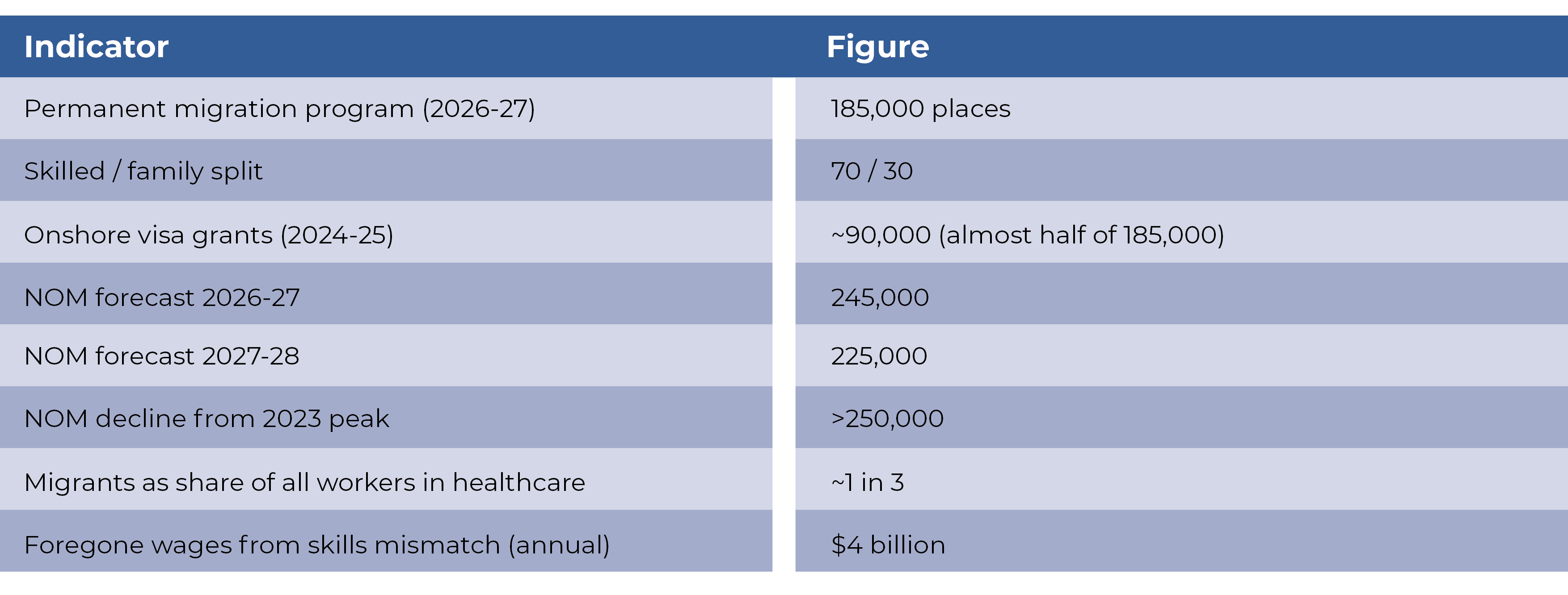
Australia's net overseas migration (NOM) surged after the pandemic as borders reopened and bipartisan policy deliberately allowed expanded intake to address acute workforce shortages. That surge has now reversed. NOM has fallen by more than 250,000 since its September 2023 peak, down to 301,000, and the Federal Government's 2026-27 Budget now forecasts it will reach 225,000 by 2027-28, roughly in line with pre-pandemic levels.
AI is changing the world order. Now is our time to shape it.
Register for the AI Leadership Summit in Sydney | 27 October


Migration is falling faster than debate acknowledges
Despite this, migration remains a flashpoint. We’ve seen political parties politicise cuts to migration at the centre of their political platforms, framing high intake as a driver of housing unaffordability and infrastructure strain.
Migration by the numbers
The post-pandemic surge is over
NOM became negative when Australia closed its borders during COVID-19. When travel resumed, built up demand and deliberate policy choices drove NOM to a record 555,800 in September 2023. Arrivals rose sharply, but so did the number of people already in Australia choosing to stay rather than depart, including international students and temporary skilled workers whose visas had been extended.
Two years of decline have followed. Arrivals have fallen by around 180,000 from their peak, though departures have not quite yet returned to pre-pandemic norms.
The program is stable and skills-focused
The 2026-27 Budget maintains the permanent migration program at 185,000 places, with a 70/30 skilled-to-family split unchanged from prior years. Around 90,000 of those places will go to people already living in Australia on temporary visas, reflecting a deliberate shift toward onshore pathways. A further 55,110 offshore places are reserved for highly skilled migrants aligned to long-term workforce needs.
Higher migration from New Zealand citizens, alongside elevated temporary visas, driven by working holiday makers and temporary skilled workers are keeping NOM above it’s long-run average.
Student visa numbers have been subject to increased scrutiny, though they have reverted in line with their 2018 figures. The 2026-27 Budget funds additional integrity measures and more rigorous offshore and onshore application assessments.
Source: Department of Home Affairs, Australia's Migration Trends 2024-25; Treasury Budget Paper No. 1, 2026-27
What migrants contribute
Migrants fill domestic skills and workforce shortages, and that matters more as the population ages.
- Around one in three workers in healthcare, logistics, professional services and manufacturing were born overseas.
- CEDA estimates the aged care sector will require 400,000 additional workers by 2050, a gap domestic supply alone cannot fill.
- Nearly one in five migrants who come to Australia work in healthcare and social assistance.
- Migrants generally arrive in their prime working years, helping to offset the fiscal pressures of an ageing population.
- Treasury analysis shows migrants make net positive fiscal contributions over their lifetimes: they pay more in tax than they use in services.
Source: ABS; CEDA (2025) Duty of Care; Varela et al. (2021), Treasury; Commonwealth Intergenerational Report 2023
Where the system falls short
The case for migration does not require ignoring its challenges. Two stand out.
Skills recognition
Overseas qualifications often go unrecognised in Australia, leaving migrants in roles below their training. CEDA estimates this mismatch costs about $4 billion in lost wages a year, a poor result for migrants and a waste of the economy's capacity. We support the recent budget announcements to address this.
- The 2026-27 Budget commits $85.2 million over four years to speed up skills assessment and occupational licensing, aiming to add 4,000 skilled trades workers to the workforce each year.
Housing and infrastructure
The link between migration and housing costs is real but often simplified and overstated. One study found a 1 per cent rise in migrants to a postcode lifts local house prices by about 0.9 per cent. Migration is only one pressure, alongside changing preferences, constrained supply, planning limits and underinvestment in infrastructure. The fix is building more homes faster, not just cutting migration.
Source: CEDA; Moallemi and Melser (2020), Papers in Regional Science
The political context
Migration has become one of the most contested policy areas in Australian politics, and stated positions are now quite distinct.
Labor: managed moderation
The Albanese government's 2026-27 Budget signals continued downward pressure on NOM while protecting the skilled and employer-sponsored streams that business and our economy depend on. The government has tightened student visa integrity, revised upward the NOM forecast due to slower-than-expected departures, and committed to reforming the Adult Migrant English Program from 2029. The framing is one of calibration rather than deep cuts: skilled migration aligned to long-term economic need, with stronger quality controls.
Coalition: housing-linked cap
Opposition Leader Angus Taylor used his Budget reply speech to propose tying NOM to the number of homes built in the previous year. His framing was direct: "Australia should only bring in as many people as it can house." The Coalition argues that migration has outpaced infrastructure and housing supply under Labor, putting pressure on rents and prices for young Australians. The policy would represent a significant structural change to how migration targets are set, introducing a housing construction variable that the government does not directly control.
One Nation: deep cuts and a cultural test
One Nation has proposed capping total visa numbers at 130,000 annually and implementing what it describes as a zero-net migration policy, focusing only on highly skilled migrants from what the party calls culturally cohesive countries. English language ability would be a prerequisite for entry. These proposals sit outside the mainstream, but given apparent electorate support, have shaped how others are framing the debate.
CEDA's position
Migration has been central to Australia's economic development and success and remains essential as our population ages and skill shortages persist. Debate should be informed by evidence and clarity regarding policy intentions and implementation strategies. CEDA supports a well-managed skilled migration system with streamlined visa pathways in priority sectors, faster skills recognition, and the planning and infrastructure investment needed to address concerns and build community confidence in migration's long-term benefits.