
AI is changing the world order. Now is our time to shape it.
Register for the AI Leadership Summit in Sydney | 27 October
26/11/2025
From family-run restaurants to boutique manufacturers or single parents with an online hustle, small and medium-sized businesses (SMBs) play a critical role in the Australian economy.
Their annual $1 trillion contribution to economic activity represents half of our private sector GDP and they generate 60 per cent of company profits. The jobs they create and the organisations they support make them the heart of local communities across Australia, particularly in regional areas.
Put simply, when small business succeeds, Australia wins. But being a SMB isn’t easy, and they often struggle to match the productivity of larger enterprises. Artificial intelligence (AI) offers a powerful way for SMBs to increase efficiency and drive economic growth, but they often lack the time or the resources to properly utilise the technology.
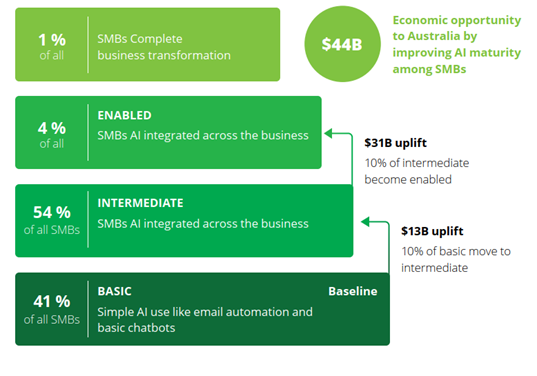
According to The AI edge for small business – a Deloitte Access Economics report produced for Amazon - just 5 per cent of more than 1000 surveyed SMBs using AI are fully enabled to realise its potential benefits. Most are using the technology intermittently while one-third don’t use it at all.
That is just not good enough. Deloitte Access Economics’ modelling indicates that if SMBs adopting AI can move from a basic to an intermediate level of maturity they could see profitability rise by about 45 per cent, and those moving from intermediate to fully enabled could experience roughly a 111 per cent uplift.
If one in 10 SMBs across these cohorts each advanced one step on the AI adoption ladder, annual GDP could increase by around $44 billion.
Productivity problem
How could a small increase in SMB AI adoption flow through to such a large economic dividend? Quite simply, it will help small businesses lift productivity closer to their large business counterparts.
SMBs consistently lag larger enterprises in productivity, both at home and abroad. Productivity Commission research shows that SMBs are significantly less productive per hour worked than large firms in most industries.
While Australian large enterprises rank among the most productive in the OECD, Australian SMBs sit in the middle of the pack compared to their international peers. The productivity gap between big and large businesses is worse in Australia than many peer countries like the UK or Germany.
This gap matters because incremental gains in SMB productivity, when scaled across the economy, can translate into substantial improvements in national income, wages, and competitiveness.
Closing this productivity gap will also help lift our national labour productivity rate, which has averaged growth of just under 0.4 per cent a year since 2015, compared to the 60-year average of 1.6 per cent.
Overcoming SMB AI adoption barriers
How can we best help SMBs adopt AI to drive these productivity gains? Our work shows SMBs often encounter these common barriers that are far from insurmountable.
Not knowing where to start
SMBs surveyed for our report expressed enthusiasm about AI adoption but a non-negligible number of respondents across all industries were uncertain as to how their business could use it.
The key enabler for adopters of AI was the ability of their team to identify the most appropriate use of AI and incorporating it to improve operational efficiency, highlighting the importance of AI literacy to AI adoption.
Business systems and data quality limitations
Without suitable business systems and data, the ability of SMBs to scale up AI solutions is being held back. Surveyed SMBs generally rely on less complex types of data (e.g.financial and customer records) to support AI solutions as opposed to sources like call centre recordings.
Workforce skills
There is a sense that SMB workforces are largely unprepared for AI, and more formal training is required. More than half of SMB workforces have basic or novice levels of familiarity with AI, while just 10 per cent have advanced AI skill levels.
Funding and investment
Many SMBs operate in highly competitive markets and often face tighter budgets, restricting their ability to make large-scale capital or technology investments without a clear return on investment.
AI governance and standards
Surveyed SMBs highlighted the need for more guidance for using AI in an ethical and responsible way but also indicated if the regulatory burden became too heavy, they may avoid AI use altogether.
With SMBs contributing so much to our economy it is vital we assess all the options available for boosting their lagging productivity. Helping SMBs overcome these five barriers so they can move up a rung on the AI adoption ladder will have considerable and beneficial flow-on effects for the rest of the economy.
Most of these barriers can be reduced to a lack of three things: time, knowledge and capital. A policy fix could be the introduction of an investment boost for small businesses, which we explore further in our report.
As this research shows, there is significant potential for SMBs to improve their productivity through a modest increase in AI adoption. The potential increase of $44 billion isn’t just a number, it represents a real opportunity for Australian entrepreneurs to prosper.
You can read the full report by Deloitte Access Economics here