
AI is changing the world order. Now is our time to shape it.
Register for the AI Leadership Summit in Sydney | 27 October
This is the first in a series of CEDA papers focused on the housing crisis in Australia. The crisis has been decades in the making, with multiple policy and planning failures across the country contributing to a shortage of affordable homes for Australians.
Without more urgent action, we risk making the “great Australian dream” of home ownership unattainable, reserved only for the lucky few with access to generational wealth. We can and should ensure that all Australians have access to the housing they need to participate fully in life. This aspiration is a key goal of CEDA’s Progress 2050 vision.
REPORT OVERVIEW
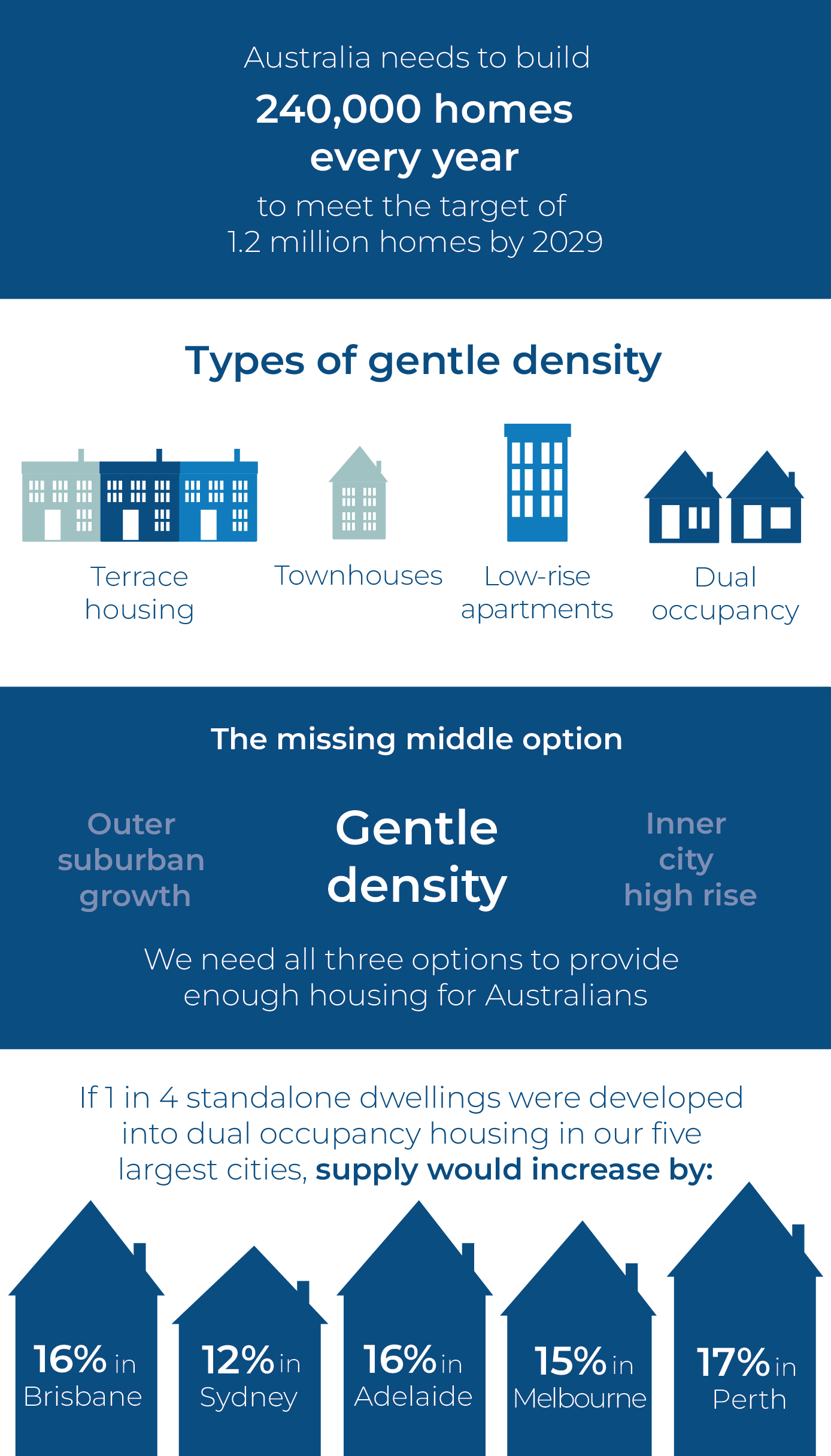
The current debate too often overlooks the significant opportunity presented by medium-density housing. Dual occupancy homes, terrace housing, townhouses and mid-rise apartments in well-located areas can deliver diverse, attainable housing while making better use of existing infrastructure and transport networks.
Even modest increases to housing density could add close to one million new homes across Australia’s five largest cities. The success of broad-based housing policy reforms in Auckland demonstrates that meaningful urban planning reform can increase supply and improve affordability.
Building consents doubled in Auckland within five years of the reforms being introduced in 2016.
Unlocking density requires planning reforms that are large-scale, encourage feasible development and enable ‘by-right’ development – housing that can be built without specific approval if it complies with local planning rules.
These changes should be supported by federal and state incentives to accelerate delivery and help overcome barriers to development such as entrenched regulation and planning restrictions, and local opposition that can outweigh broader community needs.
Without change, Australia risks perpetuating the status quo: some of the world’s highest housing prices, inadequate supply and increasingly unequal access to housing.
CONCLUSIONS
Australia’s housing crisis is decades in the making and requires action on many fronts. High-density infill and low density fringe development alone cannot provide enough homes to meet demand and aren’t always the right outcome. Embracing the middle ground of gentle density in well-located and serviced middle-ring areas is key to increasing Australia’s housing supply. States and territories should include upzoning in their housing policy mix, applying the lessons learned in Auckland, where it has helped to increase housing supply and stabilise house prices.
RECOMMENDATIONS
Zoning and planning (state and local)
- Update planning controls to facilitate an increase in dwellings per hectare and floor-area ratios. This should be done across sizable areas, such as an entire local government area or several LGAs.
- Revise zoning to allow for a broader range of mixed-use developments and land use. Thoroughly review legacy zoning from unused or underutilised land that could be updated to residential and mixed-use.
- Introduce ‘by-right’ planning rules that specify what can be built without objection based on land size. These rules should apply across large parts of the city. Few exceptions should be made for heritage, environmental and character overlays.
- Introduce fast-tracked and limited approval times. If a development is not assessed within a certain timeframe, it should be deemed automatically approved.
- Continue to pursue planning policies aimed at speeding up housing delivery, such as Transport Oriented Development (TOD), infill and Low and Mid-rise housing in NSW, and the Development Facilitation Program (DFP) and Townhouse and Low-Rise Code in Victoria.
Encourage development in well-located areas
- State governments should offer financial incentives to councils that meet their housing targets, and penalise local governments that do not. Targets can signal how much housing should be approved, and where.
- The Federal Government should set clear criteria for planning reform targets that are broad, feasible and ‘by right’, and reward state governments that deliver successful planning reforms.
- Unlock pilot programs to support local government proof of concept, such as applying pattern book standardisation to government sites.
In partnership with

Report authors

Danika Adams
Senior Economist, CEDA
Author

Mark Dawson
Partner, Urbis
Contributing Author
Danika Adams
Senior Economist, CEDA
Author
Mark Dawson
Partner, Urbis
Contributing Author